MISFITS (2024)
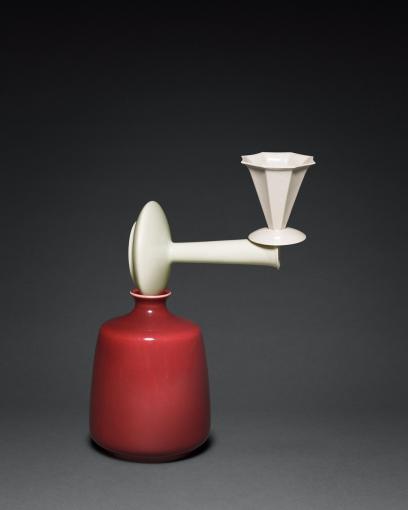
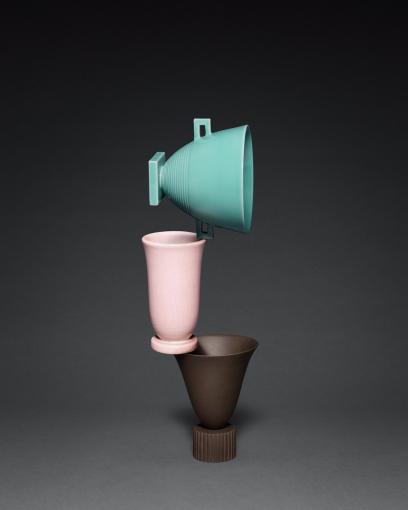
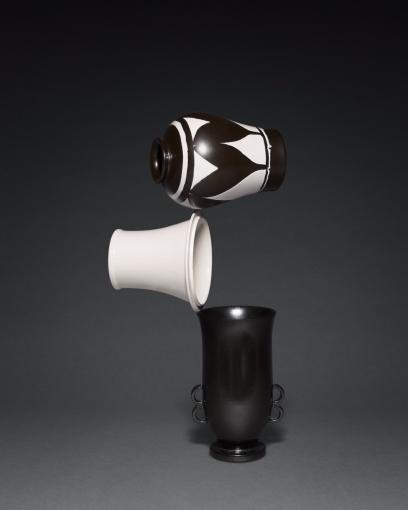
The photographic series Misfits, a work specially commissioned by the CNA – Centre national de l'audiovisuel, sees Kay Walkowiak selecting significant objects produced by the renowned firm Villeroy & Boch from the Musée national d’archéologie, d’histoire et d’art – MNAHA’s ceramic art collection, in order to effectively deconstruct the myths of the museum, and in particular those proclaiming its objectivity. A highly controlled studio aesthetic is used to photograph the objects, which have been kept in pristine condition by the museum. Withdrawn from life, they are now embalmed in the museological fantasy of eternity. Each composition depicts an extraordinary stacking of objects in a state of fragile balance that seems to defy the laws of physics. Contrary to what might have been expected, the photographic montages are not meant to conceal their “flaws” in perspective, thereby revealing Western practices of modernity and the present as an extremely precarious, deeply fragile condition. In this work, Walkowiak humorously suggests that our self-important constructions—our sovereign arrogances and empires of privilege—are, in fact, fragile structures always on the verge of collapse. The work also reflects on the ephemeral nature of all human creation and the paradox inherent in the Western concept of the museum, a space designed to suspend the passage of time. By isolating and preserving objects indefinitely, the museum enacts a quiet denial of transience—it seeks to freeze history, to maintain the illusion that culture can be extracted from the flow of life and kept untouched. Walkowiak’s precarious assemblages subtly undermine this illusion. The unstable balance of his compositions becomes a metaphor for the impossibility of halting time, turning the the museum itself into a stage on which the futility of resisting impermanence is gently, poetically exposed.
VIDEO: THE PROPHECY (2024)
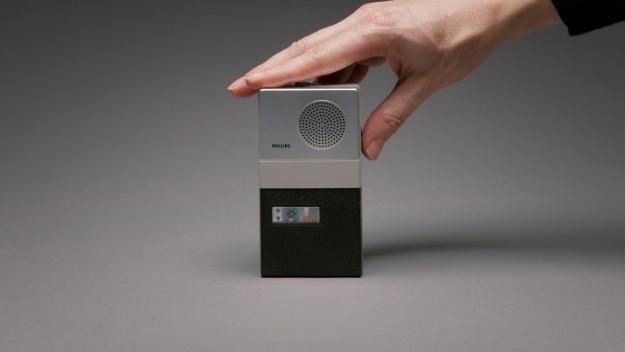
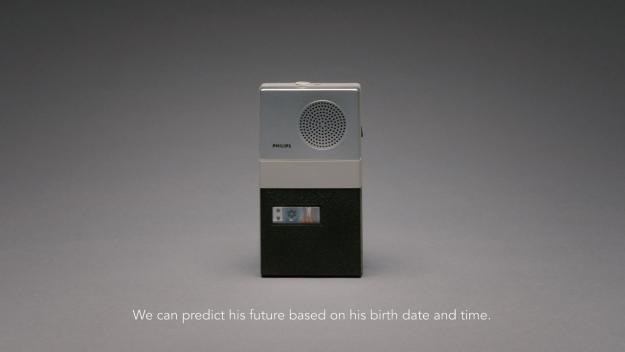
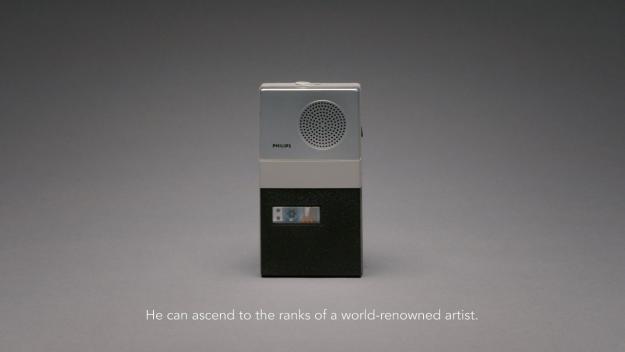
In The Prophecy, a single object becomes the site of a complex temporal negotiation: a voice recorder replays the words of a fortune teller whom the artist visited in China more than a decade earlier. The image is formally restrained and visually rigorous—a single, unwavering shot of the recorder staged within a studio environment reminiscent of a museum documentation space. Its clinical precision and near-scientific neutrality contrast sharply with the charged atmosphere of the soundtrack, in which the fortune teller confidently predicts the artist’s future success, wealth, and recognition should he pursue sculpture, photography, or film. Irony subtly permeates the work, yet its central concern lies less in skepticism than in the entanglement of temporal regimes. The prophecy, once speculative, becomes retroactively validated by its own mediation. In this convergence, past, present, and future collapse into a single audiovisual loop. By staging the prophecy as a musealized object, The Prophecy also reflects on the institutional mechanisms that confer value, authorship, and legitimacy. In relation to the photographic series Misfits the artwork suggests—without resolving—the possibility that artistic success, like prophecy itself, may be less a matter of destiny than of framing. In this sense, the artist does not simply fulfill a prediction; he constructs the conditions under which it can be perceived as true.