
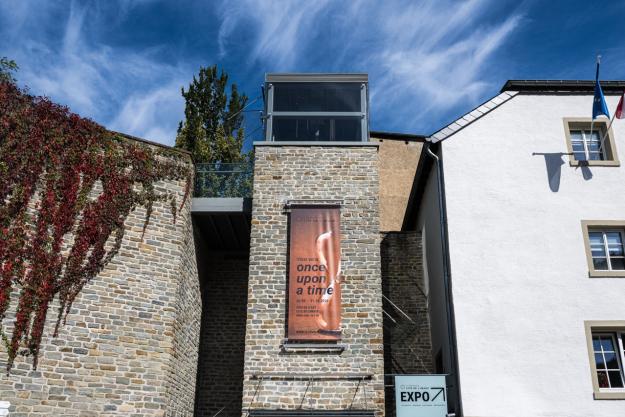
once upon a time
Each of Trixi Weis’s projects is the transfiguration of an emotion that refuses to be contained, and which comes up against the fissures linked to her personal journey or to a world that is out of control, negligent, contemptuous, wasteful, barren and belligerent. But Trixi’s perspective, connected as much to the personal as to the universal, always bypasses conventional thinking to affirm a kind of poetic and human resistance, in the manner of Jacques Tati.
Except that Trixi does not create images; at any rate, she has no ambition to be a photographer. In fact, whilst her current project is photographic, it is first and foremost an installation, and only subsequently its transposition into the medium of photography. In this instance, Frank Weber is the one behind the camera; it is he who brings to light the world to which the artist Weis gives life by reviving a bygone era, unearthing from the family cupboard objects reminiscent of Proust’s madeleine – those that speak of sharing a meal, but also of absence, so much so that they conjure up ghosts. And which, by speaking thus of solitude—of a form of abandonment born of the loss of others—lend a weight to the silence, that blanket which covers the bonds, the laughter and the values of celebrations now silenced like dust.
To this end, the project is entitled once upon a time. It nevertheless has the elegance to sidestep nostalgia by diverting the object from its function, whilst also aestheticising it – a sublimation whose subtle aim is to make us question certain societal issues, including ecology through the urgent need to care for our dwindling water supplies, as well as excess, waste, poverty and a loss of meaning, all intertwined. So what then?
In practical terms, the objects – salvaged from the family attic but also unearthed at flea markets or second-hand shops – are all used for table presentation and dining. Specifically, these are glass tableware items – a vulnerable material, a metaphor for human fragility, and translucent to boot, thus allowing light to permeate them – which, all things considered, is in keeping with the artist’s personality: at once endearing, anxious and committed, radiating much light whilst never forgetting the darkness she traverses.
At the same time, Trixi inherited her interest in glass from her great-grandfather, who designed vases for Baccarat; she has retained his appreciation for beauty and craftsmanship. In any case, the tableware she showcases is the sort one brings out for a village fair or an engagement party—made of ordinary glass or crystal depending on the occasion—whilst lamenting, in passing, the current decline in respect for beautiful things and in the passing on of traditions.
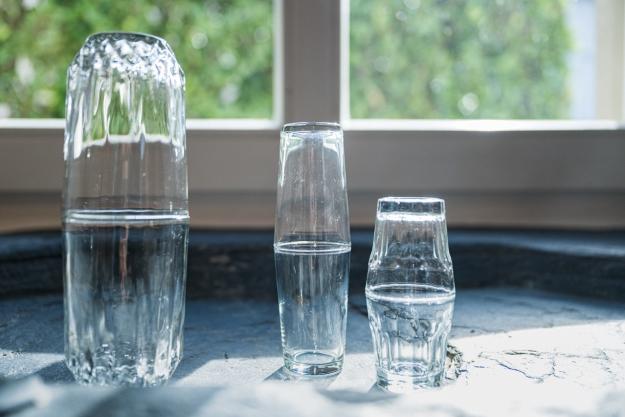
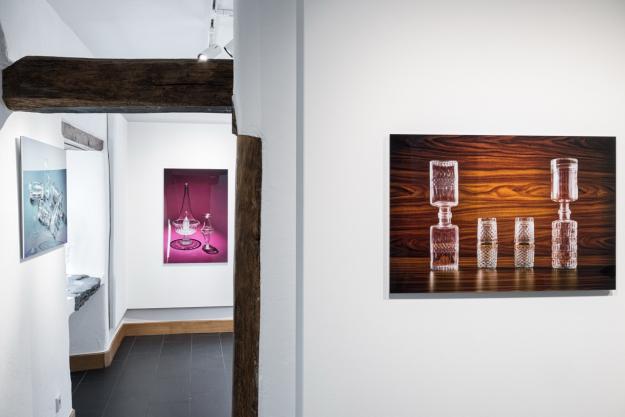
But so, taking this tableware as her starting point – with a preference for water or wine glasses – Trixi Weis combines small bowls, flan moulds, jars of spread and drinking glasses in pairs – all transparent, dry and therefore empty vessels – she combines them by stacking them upside down, thereby creating duos, couples, as if she were reassembling a family, or even a community bound by a ritual, centred first and foremost on the edible, food consumed in various ways or in a spiritual sense. Sometimes, there is a loose cannon or an isolated element – a carafe, for example – a silent witness, more or less singular, both observer and participant in a scene that either involves or excludes it.
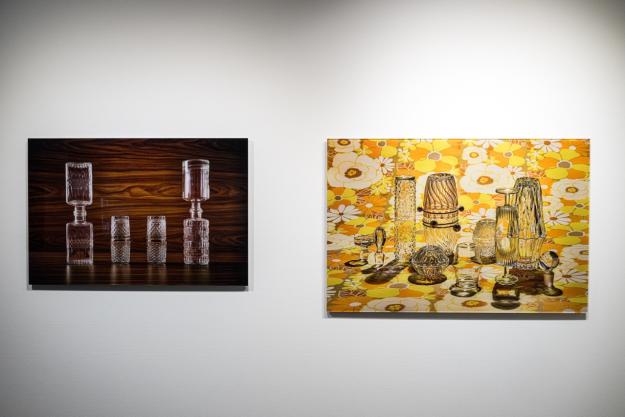
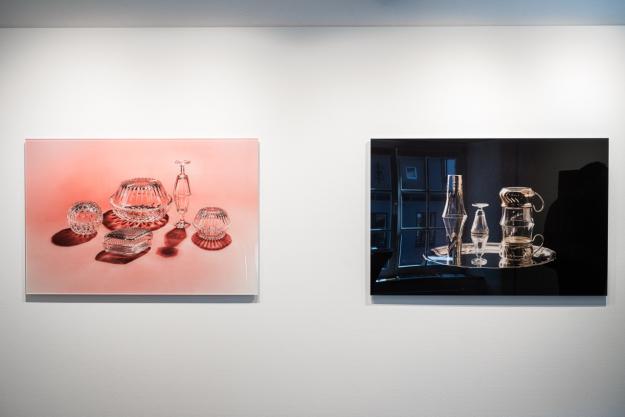
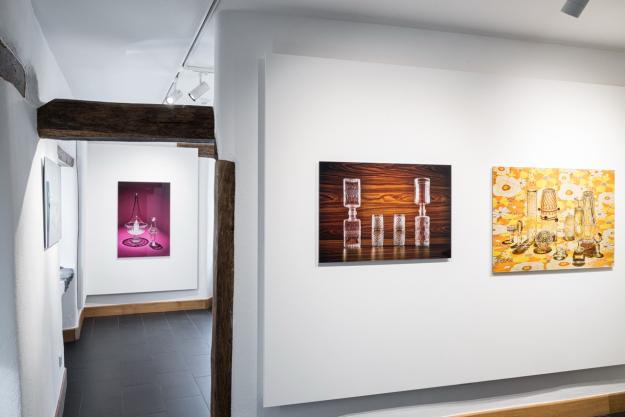
And Trixi sets this ‘family’ against a backdrop that changes each time, using monochrome or printed backgrounds, each suggesting a particular environment, drawn directly from an era, a season or a suspended moment.
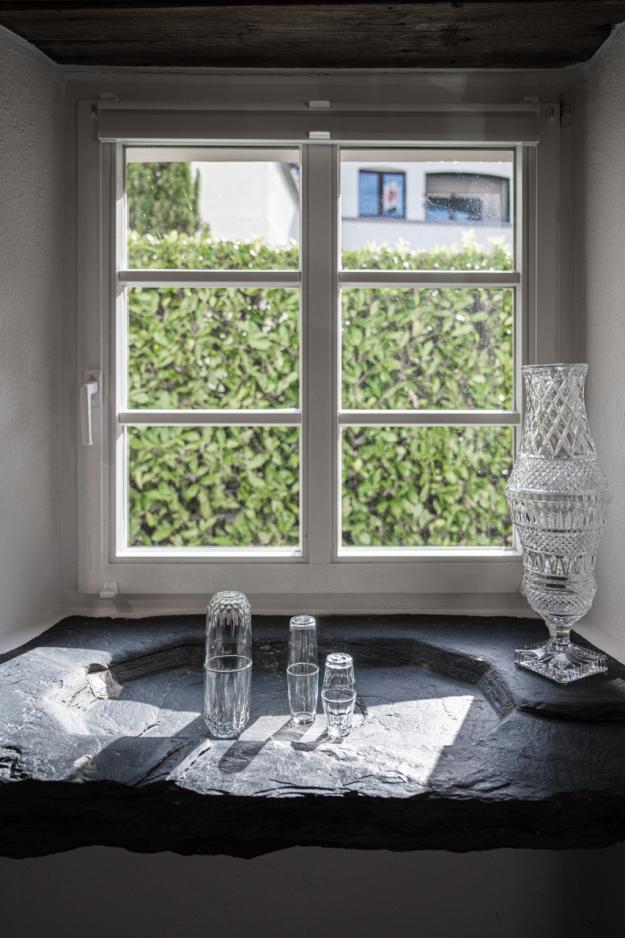
In total, there are 8 installations and as many large-format photographs. With the exception of once upon a time/ fête, the title given to an object exhibited as it is – namely, a vase capable of holding a large bouquet, placed in a niche like a sculpture.
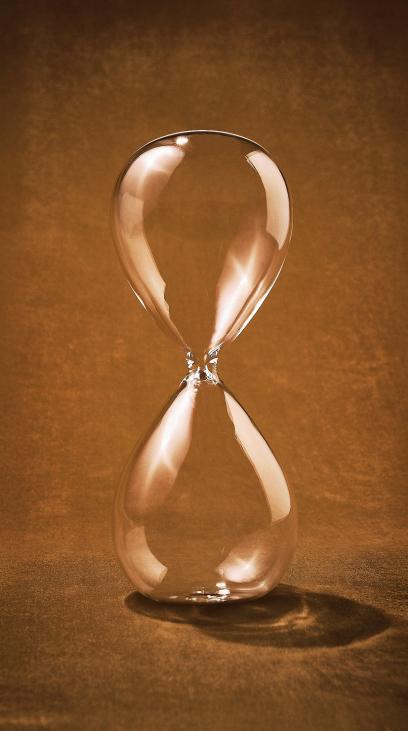
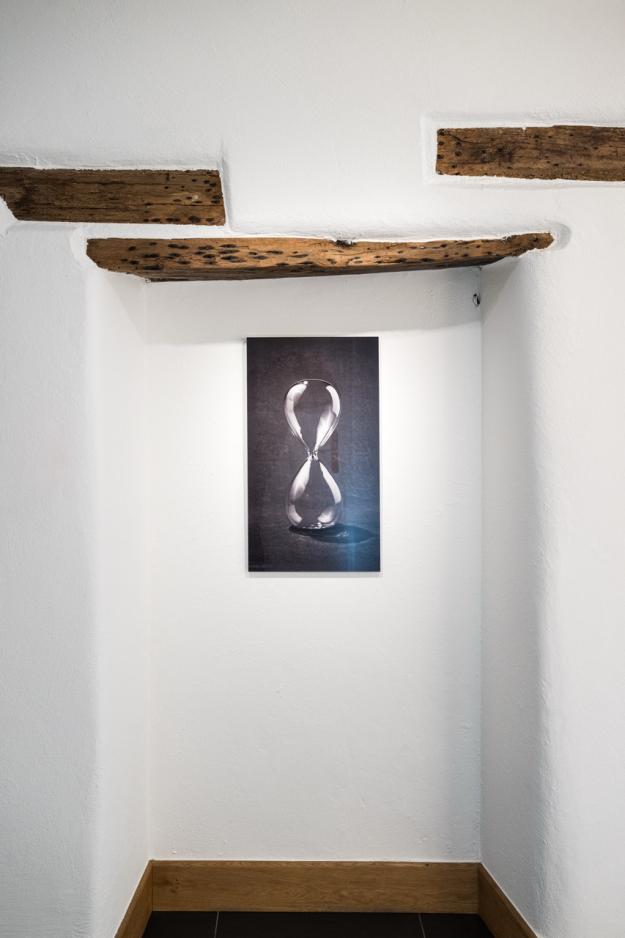
And then, there are colour photographs throughout, except for the pair of glasses evoking an hourglass… with no sand flowing through it, presented in a vertical black-and-white format. So, an hourglass without sand, powerless or incapable of measuring a span of time, or one that opens up a world of imagination, the once upon a time of the fairy tale with its indefinite timeframe.
Because, yes, Trixi Weis’s project is a journey that does not shy away from dreams, let alone the marvellous.
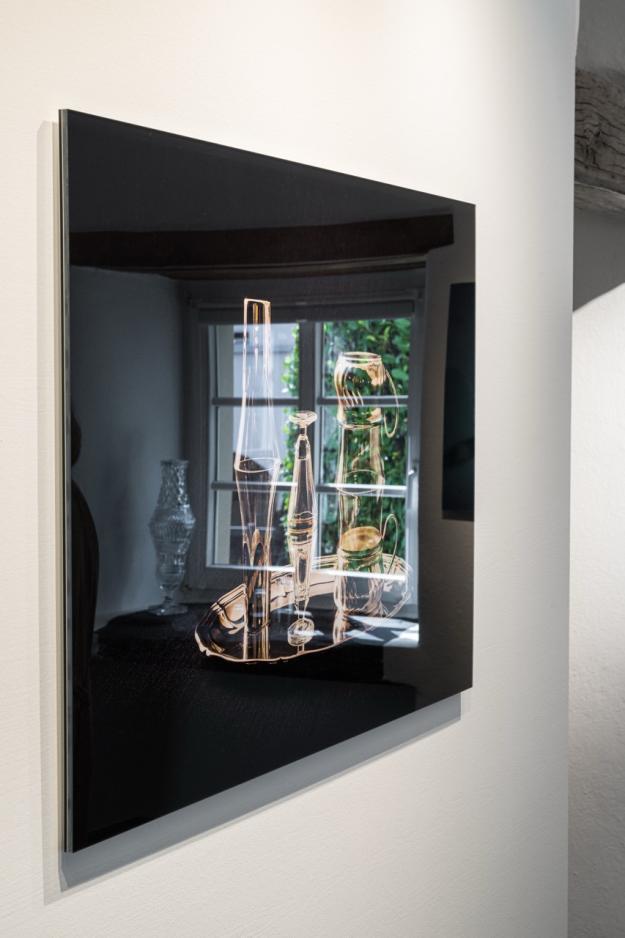
It all begins with once upon a time/amourette, followed by once upon a time/business with its whisky glasses – classy, iconic relics of the years 1945 to 1973, a period of economic growth and social progress forever known as the ‘Trente Glorieuses’.
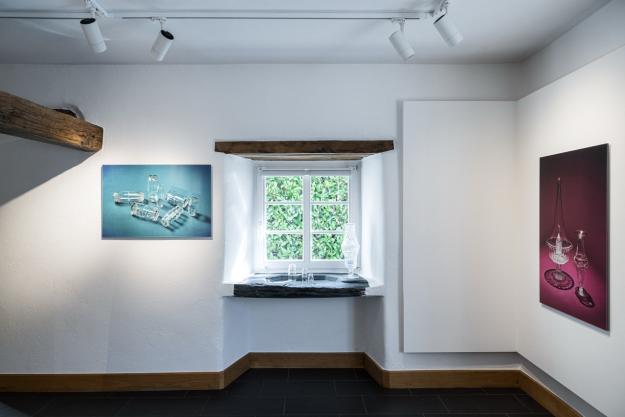
And then there is once upon a time/dimanche, where, against a bishop’s purple background, a goblet resembling a thurible, complete with an inner bell, alludes to the Eucharist, flanked by two ice cream bowls acting as altar boys – in fact, Trixi, with a mischievous twinkle, manipulates the apparent innocence of this crystalline arrangement to expose what is no longer a taboo: abuse by members of the clergy.
As for once upon a time/été, there is a return to airy lightness, with a very communal scene set against a waxed tablecloth where glasses and other pots, all mismatched and very cheap, re-enact a typical 1960s country picnic – the only thing missing is the waters’ edge with its open-air café!
Once upon a time/kermesse follows in the same vein—that of a carefree era, a light-hearted state of mind—featuring small pieces of corrugated and/or pressed glass tableware, left forgotten against a background that evokes the colour of barley sugar, the flavour and charm of candy floss.
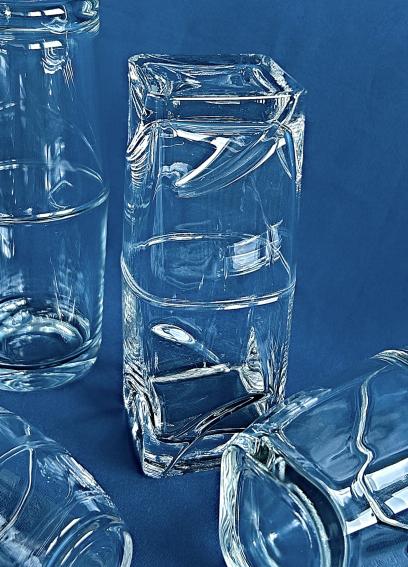
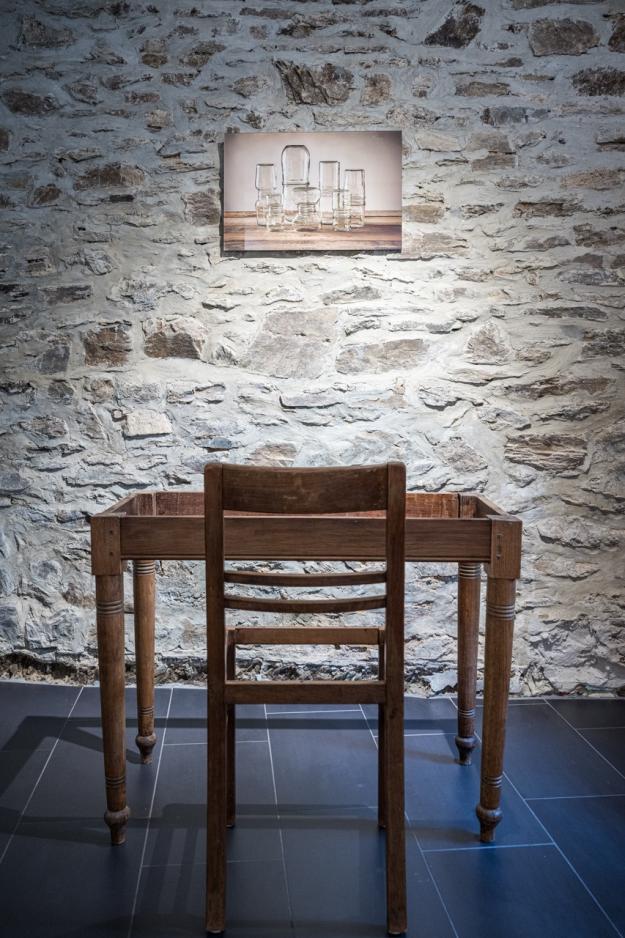
Against a turquoise background, once upon a time/quotidien zooms in on a plain, unadorned water glass, as oblong as a capsule and placed at a jaunty angle. Finally, once upon a time/garde-manger presents a vibrant spatial arrangement: thus, in a room, at the centre, a table without a top, a chair without a seat, solitary from waiting or having waited, and opposite the installation, suspended from a cut-stone wall, a small photograph – mounted under acrylic glass like all the others in the series – manages to express what eludes words: Everything is absence that speaks of presence.
Once upon a time – or tell me which object shapes your daily life and your memory, and I shall tell you who you are – overflows with interpretations and emotional and narrative threads, in tune with time past or present, with the weather, with the time of day, and also with what is missing but once existed…
Marie-Anne Lorgé
Biography
Trixi Weis was born in Luxembourg in 1967.
She studied sculpture at La Cambre in Brussels until 1993 and multimedia techniques at the Academy of Fine Arts in Prague, where she worked until 1997. Since then, she lives and works in Luxembourg. She is a founding member of the Luxembourg Association of Visual Artists, which she chaired from 2013 to 2021.
Winner of several artist residencies, notably in France, Germany, the Netherlands, and Japan, she exhibits regularly in Luxembourg and abroad. Her work is represented in public collections in Luxembourg.
Through numerous artistic practices and a wide variety of materials, Trixi Weis creates works that each tell a story. Although the artist rejects serial work, her oeuvre reveals certain recurring themes, such as fairy tales in her early career or ephemeral site-specific installations in natural environments. Other creations, with food as subject and material, are interactive. Trixi Weis readily places herself on stage in performances, videos, and small kinetic sculptures, exploring themes of solitude, celebrations, love, and sexuality. More recently, her performances and installations critizise our consumer society. She also creates monumental sculptures and LED light installations for public buildings and regularly designs sets and costumes for theater and dance.
In these latter areas, she is recognizable through a certain minimalism, which does not preclude joy or playfulness. All her works, even those addressing more serious subjects, almost always incorporate a touch of humor, making Trixi "...a mischievous, gently subversive artist."
Practical information
Address:
Centre d'Art - Cité de l'image
11, Grand-Rue
L-9711 Clervaux
Opening hours:
Mon - Sun: 10 am - 5 pm
Free admission
Exhibition views
© Cité de l’image / Mike Zenari